
Bluetooth Low Energy Fuzzing in Medical Devices

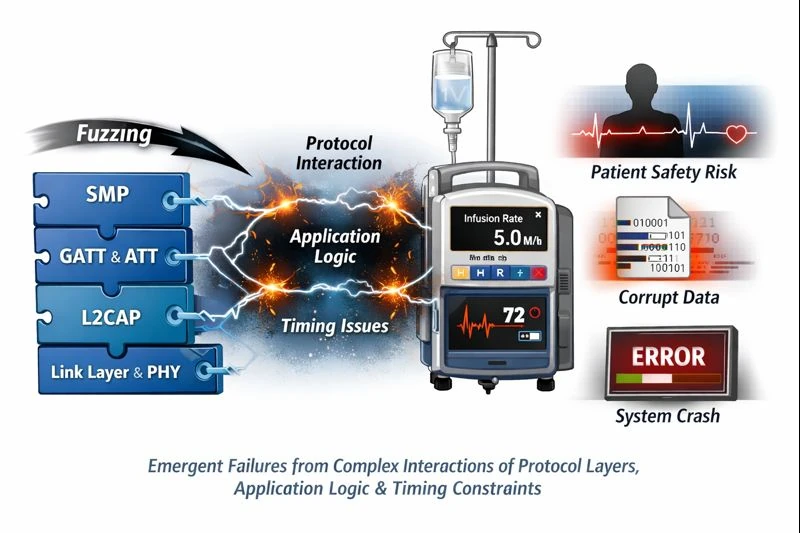
Fuzzing BLE medical devices is fundamentally about exercising stateful, safety-critical protocol behavior over time. The vulnerabilities that matter most are not isolated parsing bugs, but emergent failures arising from complex interactions between protocol layers, application logic, and timing constraints. Naïve BLE fuzzing approaches fail because they ignore this reality. By contrast, a workflow-aware, stateful approach, such as that implemented by Penzzer, aligns fuzzing activity with how medical devices actually behave. By modeling GATT workflows, respecting protocol semantics, and inferring failures through indirect observation, it becomes possible to systematically explore behaviors that would otherwise remain untested. In this sense, BLE fuzzing is less about breaking the protocol and more about understanding how safety-critical systems respond when their assumptions are stressed. That understanding is essential for both security research and responsible medical device engineering.

Bluetooth Low Energy (BLE) is often described as a layered stack, but for security analysis, particularly in medical devices, the layers are less important as abstractions than as boundaries where state, timing, and assumptions accumulate. BLE vulnerabilities rarely arise from isolated packet parsing errors; they emerge from interactions across layers under constrained conditions.

At the physical layer, BLE operates in the 2.4 GHz ISM band using frequency hopping across 40 channels, three of which are dedicated advertising channels. For medical devices, PHY-level decisions are typically driven by regulatory coexistence requirements and power constraints rather than performance. Many devices use legacy 1 M PHY exclusively, even when newer PHYs are supported by the controller, because validated radio behavior is considered part of the safety case. This limits throughput and increases sensitivity to retransmissions, which has downstream implications for fuzzing: malformed higher-layer behavior may surface as PHY-level congestion, connection drops, or controller resets rather than clean protocol errors.

The Link Layer defines advertising, scanning, initiating, connection establishment, and connection maintenance. It is here that BLE's role asymmetry, central versus peripheral, first becomes explicit. Most medical devices act as peripherals, exposing services to a clinician programmer, a bedside monitor, or a mobile application. The Link Layer also governs connection parameters such as connection interval, slave latency, and supervision timeout. These parameters are not merely performance optimizations; they are often tightly coupled to firmware scheduling and power management. Fuzzing that perturbs higher-layer timing without regard for Link Layer constraints frequently produces misleading results, such as spurious disconnects that mask real logic faults.

L2CAP in BLE is significantly simplified compared to classic Bluetooth. Its primary role is multiplexing higher-layer protocols and providing segmentation and reassembly for ATT. From a fuzzing perspective, L2CAP fragmentation is one of the first places where stateful behavior becomes unavoidable. Long Attribute Protocol transactions rely on predictable segmentation semantics, and incorrect handling can desynchronize attribute state without immediately triggering errors.

ATT and GATT together form the core of BLE’s application data model. ATT defines a request–response protocol over a single logical channel, with strict sequencing and limited concurrency. GATT builds a hierarchical data model of services, characteristics, and descriptors on top of ATT transactions. In medical devices, this model often encodes both telemetry and control surfaces: sensor data, configuration parameters, alarms, and sometimes safety-critical actuation commands. The apparent simplicity of GATT, read, write, notify, hides the fact that these operations are often gateways into complex internal workflows.

Security Manager Protocol (SMP) governs pairing, bonding, key distribution, and attribute access permissions. Medical devices frequently operate in constrained pairing modes, such as Just Works or pre-provisioned bonding, to reduce user friction. These choices have security implications, but they also affect fuzzing: many interesting code paths are reachable only after specific pairing or bonding states are established.

Across all layers, medical devices impose additional constraints: limited CPU, aggressive sleep scheduling, watchdog timers, and safety interlocks designed to fail safe rather than fail open. Effective BLE fuzzing must work within these constraints rather than treating them as noise.

Security-Relevant Design Choices in Medical Devices

Medical BLE devices are designed under a fundamentally different set of assumptions than consumer wearables. Power consumption is often constrained not only by battery life but by thermal and electromagnetic compatibility considerations. Firmware execution is typically partitioned between a vendor BLE stack, application logic, and sometimes a certified safety kernel. Timing budgets are conservative, and unexpected delays can trigger watchdog resets or safety shutdowns.

From a security perspective, this means that malformed protocol behavior is more likely to surface as timing anomalies, missed deadlines, or state rollbacks than as clean crashes. A fuzzing strategy that equates "disconnect" with "failure" will miss entire classes of logic errors that manifest only after reconnection or during prolonged operation.

Safety requirements further complicate matters. Many devices deliberately limit error reporting to avoid exposing internal state or confusing clinical operators. Error paths may be silent, deferred, or intentionally lossy. For fuzzing, this implies that absence of feedback does not imply absence of effect.

Finally, regulatory validation often freezes protocol behavior early in the product lifecycle. Devices may ship with known quirks that are never patched unless they rise to the level of a reportable safety issue. Fuzzing such devices is therefore not about finding exotic edge cases in cutting-edge stacks, but about systematically exploring the dark corners of mature, ossified implementations.

Threat Model for BLE Medical Devices

A realistic threat model for BLE medical devices must avoid both extremes: assuming nation-state adversaries with physical access to firmware, or assuming purely opportunistic attackers limited to passive eavesdropping.

The most plausible attacker is within RF proximity and can act as a BLE central. This may be a malicious mobile application, a compromised clinician programmer, or a rogue device in a clinical environment. In many cases, the attacker can pair with the device legitimately, either because pairing is unauthenticated or because credentials are shared across fleets. Bonded attackers are particularly relevant, as many sensitive GATT characteristics are accessible only after bonding.

Patient safety is the primary concern, but not all vulnerabilities translate directly into physical harm. Data integrity violations, such as corrupting stored configuration parameters, or availability issues, such as forcing repeated resets, can have clinical impact even if actuation is not directly controlled. From a fuzzing standpoint, these outcomes are often easier to trigger than outright command injection.

Regulatory expectations shape how these threats are assessed. The FDA and similar bodies increasingly expect manufacturers to demonstrate proactive vulnerability discovery, including post-market surveillance and coordinated disclosure. Fuzzing is relevant not as a compliance checkbox, but as a mechanism to surface classes of failures that static analysis and conformance testing cannot reveal.

Why Traditional Fuzzing Fails for BLE

Traditional fuzzing techniques, particularly mutation-based packet fuzzing, struggle with BLE because they assume statelessness or shallow state. BLE, by contrast, is deeply stateful at every layer above the PHY.

ATT enforces strict request-response ordering. Sending a malformed request at the wrong time does not test parser robustness; it simply violates the protocol and is discarded. GATT semantics add another layer of state: characteristics may behave differently depending on prior writes, notifications may depend on configuration descriptors, and long writes involve multi-step prepare/execute workflows.

Timing sensitivity further undermines naïve fuzzing. Many BLE stacks assume that requests arrive within specific intervals and that certain operations complete before others begin. Randomizing inter-packet timing without understanding these assumptions often results in immediate disconnects that prevent deeper exploration.

Mutation-only fuzzers also fail to respect semantic boundaries. Flipping random bits in a characteristic value may never reach application logic if the value is range-checked early. Conversely, subtle semantic violations, such as writing valid-looking values in an unexpected sequence, can trigger logic flaws that byte-level mutation will never discover.

Finally, BLE fuzzing often targets individual packets rather than workflows. Medical device behavior is rarely triggered by a single write; it emerges from sequences of reads, writes, notifications, and timing interactions over minutes or hours.

BLE Fuzzing Methodology: Exercising Stateful, Safety-Critical Behavior

Effective BLE fuzzing begins with explicit state modeling. Rather than treating the device as a black box that accepts arbitrary packets, the fuzzer models the expected protocol states and deliberately attempts to transition between them in valid and near-valid ways. This includes connection establishment, MTU negotiation, service discovery, pairing, bonding, and application-level workflows encoded in GATT.

Workflow-aware fuzzing focuses on sequences rather than individual operations. For example, a configuration parameter may only be applied after a commit characteristic is written, or after a notification is enabled. Fuzzing these workflows involves perturbing order, timing, and values while remaining within the protocol’s syntactic constraints.

Temporal fuzzing is particularly relevant for medical devices. Delaying a response, repeating a request after a timeout, or interleaving operations that are normally serialized can reveal race conditions and inconsistent state handling. These behaviors are difficult to exercise manually and are rarely covered by conformance tests.

ATT and GATT transaction fuzzing must account for long writes, MTU changes, and error responses. For instance, sending a valid prepare write sequence with inconsistent offsets can stress buffer management without immediately violating protocol rules. Similarly, negotiating an unusually large MTU and then exercising edge-case characteristics can expose assumptions about buffer sizes.

SMP fuzzing is often overlooked but remains relevant. Pairing edge cases - such as interrupted key distribution or repeated pairing attempts - can leave devices in partially initialized states that affect subsequent GATT behavior.

Crash detection in medical devices cannot rely solely on process termination. Instead, fuzzers must infer failure from indirect signals: unexpected disconnects, changes in response timing, altered attribute values, or persistent state changes across reboots. Safety considerations require that fuzzing be conducted in controlled environments, with clear criteria for aborting tests that could affect device function.

Using Penzzer to Fuzz a BLE Medical Device

The core challenge in BLE fuzzing is bridging the gap between protocol correctness and application-level behavior. Penzzer approaches this by modeling BLE interactions as explicit state machines and workflows rather than as isolated packet exchanges.

At the BLE level, Penzzer maintains an internal representation of connection state, negotiated parameters, and discovered attributes. This allows it to generate ATT and GATT transactions that are syntactically valid and contextually appropriate. Rather than blindly mutating bytes, Penzzer mutates semantics: characteristic values, write sequences, timing relationships, and state transitions.

Black-box operation is central. Penzzer does not require firmware access, debug interfaces, or proprietary knowledge of the device. It interacts with real hardware using standard BLE controllers, relying on observed behavior to refine its state model. This is particularly important for medical devices, where invasive instrumentation may be impractical or prohibited.

Target selection begins with service and characteristic discovery. Penzzer enumerates the GATT database and classifies characteristics based on properties, permissions, and observed behavior. Characteristics that support write or write-without-response operations are natural targets, but read-only and notify-only characteristics are also relevant when considered in workflows.

Semantic mutation is applied at the level of characteristic values and sequences. For example, if a characteristic appears to encode an infusion rate or alarm threshold, Penzzer can generate values that are within expected ranges but violate implicit assumptions, such as rapid oscillation between extremes or inconsistent units across related characteristics. The goal is not to guess the meaning of values, but to systematically explore the space of plausible inputs.

Timing and retransmission handling are integral. Penzzer controls inter-transaction delays, deliberately introduces jitter, and can replay or reorder operations to probe race conditions. Notifications and indications are treated as asynchronous events that can influence subsequent behavior. Penzzer tracks these events and incorporates them into its state model rather than ignoring them as background noise.

Without firmware instrumentation, coverage must be inferred indirectly. Penzzer uses proxies such as response diversity, timing variation, and persistent state changes to estimate exploration depth. For example, a sudden increase in response latency after a specific sequence may indicate entry into an error-handling path.

Failure detection is similarly indirect. Rather than treating disconnects as terminal failures, Penzzer distinguishes between expected protocol-level disconnects and anomalous behavior, such as repeated resets or altered GATT databases after reconnection. In medical devices, persistent misconfiguration is often more concerning than transient crashes.

Concrete fuzzing scenarios illustrate these mechanisms. Consider a wearable infusion pump exposing GATT characteristics for basal rate configuration and telemetry reporting. Penzzer can model the workflow by which parameters are written, validated, and applied. By fuzzing the timing and sequencing of these writes, such as interrupting configuration mid-application or rapidly toggling values, it can surface logic flaws that leave the device in inconsistent states, even if no explicit error is reported.

Similarly, telemetry characteristics that stream sensor data can be fuzzed indirectly by manipulating subscription parameters, MTU sizes, and connection intervals, stressing buffer management and scheduling logic without ever writing malformed values.

Hardware and Test Setup

Hardware selection matters for BLE fuzzing. The BLE controller must support precise timing control, reliable capture of notifications, and stable operation under high transaction rates. Commodity USB dongles are often sufficient, but their firmware behavior should be understood to avoid conflating controller limitations with device vulnerabilities.

Isolation is critical. Medical devices under test should be removed from clinical environments and configured in modes that disable actual therapy delivery where possible. Power cycling, shielding, and RF isolation help ensure that fuzzing does not interfere with other equipment.

Logging and reproducibility are essential. Every fuzzing session should record transaction sequences, timing, and observed behavior to enable minimization and triage. Because many BLE failures are non-deterministic, reproducing an issue may require replaying not just values but precise timing relationships.

Test-case minimization focuses on workflows rather than packets. The goal is to reduce a complex sequence to the minimal set of interactions that trigger the observed behavior, preserving state transitions and delays that are essential to reproduction.

Vulnerability Classes and Realistic Outcomes

BLE fuzzing of medical devices tends to uncover a consistent set of vulnerability classes. Memory corruption can occur in long write handling or notification buffering, particularly when assumptions about MTU or segmentation are violated. Logic flaws are more common, manifesting as inconsistent configuration states, bypassed validation, or unintended mode transitions.

State desynchronization is a particularly subtle class. The device and client may disagree about configuration state after an interrupted workflow, leading to incorrect operation without obvious errors. Denial of service is often observed as repeated resets or refusal to reconnect, which may have clinical impact even if easily recoverable in a lab.

From a regulatory perspective, these outcomes matter because they challenge assumptions about robustness. Even if no exploit is demonstrated, the existence of uncontrolled failure modes can trigger remediation obligations.

Operationalizing Results

Fuzzing results must be translated into actionable findings. This involves correlating observed behavior with potential root causes, assessing safety impact, and prioritizing remediation. For medical devices, integration into the secure development lifecycle includes documenting findings for risk management files, updating threat models, and feeding lessons learned into future designs.

Post-market obligations increasingly require manufacturers to demonstrate ongoing security monitoring. BLE fuzzing can be repeated across firmware versions to detect regressions and validate fixes, provided that test setups and workflows are carefully controlled.

Other Post
Uncover Hidden Vulnerabilities

Identify security flaws before attackers do, automatically and at scale with Penzzer's intelligent fuzzing engine.

Thank you! Your submission has been received!
Oops! Something went wrong while submitting the form.