
Programmable Logic Controller Fuzzing (PLC)

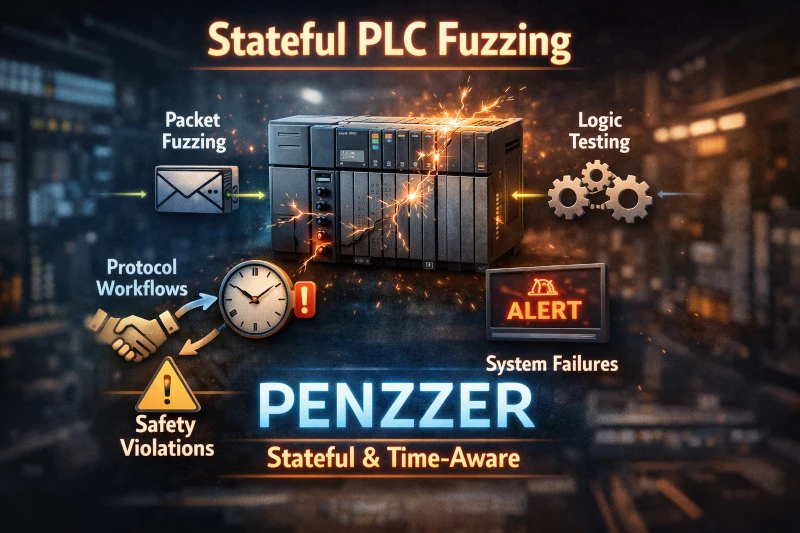
Stateful PLC fuzzing exposes safety-critical, real-world vulnerabilities by exercising protocol workflows, timing, and logic interactions; Penzzer enables semantic, time-aware campaigns that reveal failures beyond traditional packet-based testing.

PLC and ICS Architecture

Programmable Logic Controllers (PLCs) are deterministic, real-time embedded systems designed to execute control logic continuously against physical processes. Unlike general-purpose embedded devices, PLCs are architected around predictable execution cycles, persistent memory models, and rigid I/O timing constraints. These properties, while essential for safe industrial automation, create distinctive security behaviors that differ sharply from IT systems.

At a hardware level, a PLC typically consists of a CPU module, volatile and non-volatile memory regions, fieldbus or Ethernet communication interfaces, and discrete or analog I/O modules. The CPU executes user-defined control programs stored in non-volatile memory, frequently mirrored or staged in RAM for execution. Program memory is distinct from data memory, which holds I/O states, internal variables, timers, counters, and diagnostic registers. Safety PLCs introduce redundant CPUs, lockstep execution, safety-certified runtimes, and stricter separation between standard and safety logic.

Execution follows a scan-cycle model: read inputs, execute logic, update outputs, then handle communication and diagnostics. Scan times are deterministic and often configurable, with watchdogs enforcing upper bounds. Deviations from expected scan timing can trigger faults, safe-state transitions, or process interruptions.

PLC programming languages defined by IEC 61131-3, Ladder Logic (LD), Function Block Diagram (FBD), Structured Text (ST), Sequential Function Charts (SFC), and Instruction List (IL), compile into vendor-specific intermediate representations executed by proprietary runtimes. These runtimes expose internal services for program upload/download, online edits, force commands, diagnostics, and debugging. Many of these services are reachable remotely via industrial protocols.

Deployment topologies place PLCs deep inside operational technology (OT) networks, often behind segmented zones but increasingly reachable due to remote maintenance, centralized engineering workstations, and IT/OT convergence. PLCs implicitly trust upstream controllers, HMIs, and engineering tools, a trust model that heavily influences protocol design and security posture.

PLC Communication Protocols and the Attack Surface

PLC communication protocols were historically designed for reliability, determinism, and ease of integration: not adversarial environments. As a result, many protocols expose rich, stateful services with minimal authentication, weak session semantics, and complex error handling.

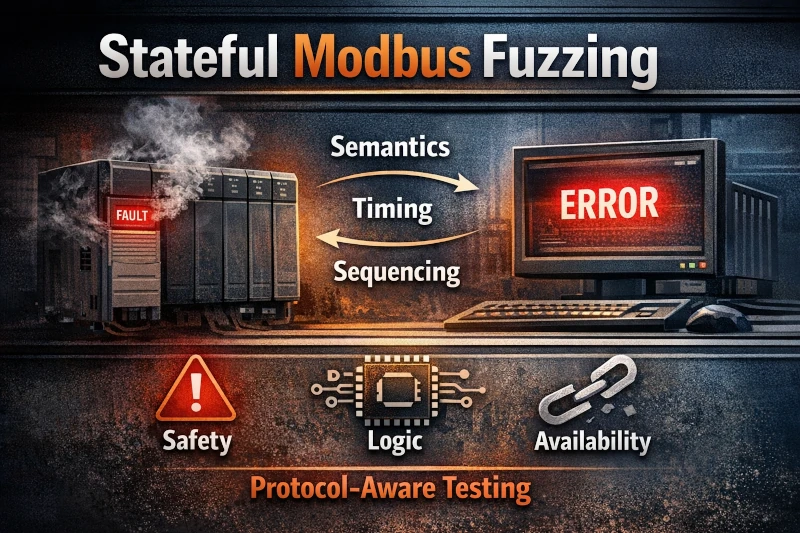
Modbus (TCP/RTU) is largely stateless at the application layer but exposes direct read/write access to coils, registers, and memory areas. The lack of authentication and coarse access controls make semantic fuzzing of function codes, address ranges, and timing interactions particularly effective.

EtherNet/IP (CIP) introduces a richer object model with explicit and implicit messaging, session registration, connection IDs, and real-time I/O assemblies. State is maintained across sessions, with implicit assumptions about message ordering, timing, and client behavior. CIP services for program upload, tag access, and device configuration create broad fuzzable surfaces.

PROFINET integrates tightly with real-time Ethernet, using cyclic I/O, acyclic services, and engineering-specific RPC mechanisms. Its complexity lies in timing guarantees, connection setup, and diagnostic state machines, which are sensitive to malformed or out-of-sequence traffic.

Siemens S7 protocols expose extensive PLC internals, including memory access, block management, and CPU control. Session setup, PDU negotiation, and function-specific state transitions present numerous opportunities for state confusion and logic corruption.

DNP3, common in electric utilities, maintains robust session and sequence handling but still exposes complex state machines and error recovery logic, particularly in outstation implementations.

Across these protocols, the attack surface is not limited to parsing. Instead, it emerges from protocol-driven workflows: connect, negotiate capabilities, authenticate (if at all), perform privileged operations, handle errors, and recover state. These workflows are inherently stateful and time-dependent, making them unsuitable for naive fuzzing approaches.

Threat Model for PLC Environments

Realistic PLC threat models assume attackers rarely start with direct field-level access. More commonly, attackers gain a foothold through compromised engineering workstations, HMIs, historians, VPN gateways, or IT systems bridged into OT networks. From these positions, attackers can legitimately speak industrial protocols, often without triggering alarms.

Attackers may operate in passive reconnaissance modes initially, then escalate to active manipulation: reading process variables, forcing outputs, modifying logic, or disrupting availability. In contrast to IT systems, confidentiality breaches are often secondary to integrity and availability impacts. Incorrect actuator states, delayed control loops, or corrupted logic can cause physical damage or safety incidents.

PLC fuzzing must therefore assume attackers with valid network access, protocol fluency, and the ability to maintain long-lived sessions. The goal is not simply crashing a device, but inducing unexpected behaviors that violate safety, reliability, or control assumptions.

Why Traditional Fuzzing Fails in PLC Contexts

Traditional fuzzing techniques - stateless packet mutation, blind randomization, or coverage-only approaches - fail to expose meaningful PLC vulnerabilities for several reasons.

First, PLC protocols are deeply stateful. Many commands are only accepted after specific handshakes, session registrations, or mode transitions. Random packet injection is typically ignored or rejected without exercising meaningful code paths.

Second, timing matters. PLC runtimes assume deterministic communication patterns aligned with scan cycles. Flooding, jitter, or malformed timing can trigger watchdogs or communication resets, masking deeper logic flaws.

Third, safety mechanisms obscure failures. PLCs often fail closed, entering safe states rather than crashing. These transitions may look benign externally but represent serious vulnerabilities if they can be triggered remotely.

Finally, many impactful vulnerabilities are emergent. They arise from interactions between protocol layers, runtime logic, and process state. Examples include partial program updates, inconsistent memory views, or race conditions between communication and execution threads. Such failures cannot be found by mutating single packets in isolation.

Effective PLC fuzzing therefore requires state awareness, semantic understanding, and temporal control.

PLC Fuzzing Methodology

A practical PLC fuzzing methodology begins by modeling the target protocol as a set of valid workflows rather than isolated messages. This includes session establishment, capability negotiation, authentication (where present), privileged operations, error handling, and teardown.

Stateful fuzzing maintains protocol state explicitly, tracking session IDs, sequence numbers, negotiated parameters, and PLC modes. Mutations are applied within valid states to push the device into edge conditions rather than being rejected outright.

Semantic mutations operate on protocol fields with operational meaning: memory addresses, data types, program blocks, object IDs, and timing parameters. For example, fuzzing program download sequences involves manipulating block sizes, offsets, ordering, and commit semantics.

Workflow-driven fuzzing chains operations across time: connect → authenticate → upload logic → force variables → observe execution → trigger diagnostics. Vulnerabilities often emerge only after sustained interaction.

Timing-aware fuzzing controls inter-message delays, burst patterns, and alignment with scan cycles. Subtle timing variations can expose race conditions between communication handlers and control logic.

Safe testing strategies are essential. Many PLC fuzzing campaigns run in lab environments with hardware-in-the-loop, process simulators, or safety-rated interlocks. For live systems, fuzzing must be constrained to non-destructive operations, with strict rollback and monitoring.

Classes of Vulnerabilities Uncovered by PLC Fuzzing

Systematic PLC fuzzing uncovers vulnerabilities rarely visible through static analysis or compliance testing.

Authentication and authorization flaws include bypassable access controls, privilege escalation via undocumented services, and inconsistent enforcement across protocol functions.

Logic corruption vulnerabilities arise when malformed or out-of-order program updates partially overwrite control logic, leaving the PLC in undefined states without triggering faults.

Memory handling issues include out-of-bounds access to data blocks, inconsistent type handling, and stale pointer references across scan cycles.

Race conditions emerge between communication tasks and logic execution, particularly during online edits, force operations, or mode transitions.

Denial-of-service and safety impacts often manifest as watchdog triggers, scan overruns, or forced safe states. While not crashes, these behaviors can halt production or induce unsafe process conditions.

Notably, many vulnerabilities appear only in field firmware versions or specific hardware revisions, highlighting differences between lab testing and operational reality.

Using Penzzer for PLC Fuzzing (Core Section)

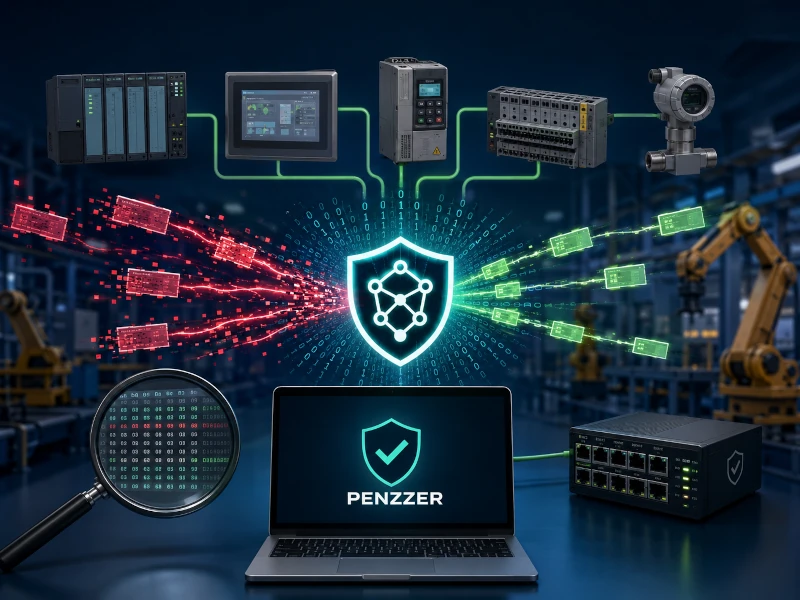
Penzzer approaches PLC fuzzing by treating industrial protocols as state machines with semantic intent, rather than byte streams. Protocol models encode valid states, transitions, and constraints, enabling fuzzing campaigns to remain inside meaningful execution paths.

For PLC protocols, Penzzer maintains session context, negotiated parameters, and runtime modes. Campaigns are constructed as workflows: for example, establishing a CIP session, enumerating objects, initiating a program download, and manipulating execution states. Mutations are applied selectively at each stage.

Penzzer supports both black-box and grey-box approaches. In black-box mode, observability relies on protocol responses, timing deviations, connection resets, and PLC status indicators. Grey-box modes can incorporate engineering diagnostics, debug interfaces, or process telemetry to detect subtle logic deviations.

Instrumentation focuses on behavioral anomalies: unexpected mode changes, inconsistent variable values, scan time deviations, or protocol desynchronization. Rather than seeking crashes, Penzzer flags state divergence from expected operational models.

Timing control is central. Penzzer schedules message sequences relative to scan cycles, allowing exploration of race windows that static fuzzers cannot reach. Safety constraints can be encoded to prevent destructive actions, such as forcing physical outputs beyond safe ranges.

Practical PLC Fuzzing Scenarios with Penzzer

One common scenario involves fuzzing program download workflows. Penzzer models the sequence of block transfers, acknowledgments, and commit operations. Mutations include reordering blocks, truncating transfers, duplicating commits, or injecting malformed metadata. Observations focus on partial logic execution, silent corruption, or inconsistent rollback behavior.

Another scenario targets runtime control commands, such as force/unforce operations or mode transitions. By fuzzing timing and sequencing, Penzzer can expose conditions where forces persist unexpectedly or execution modes desynchronize.

Error-handling paths are particularly fertile. Penzzer deliberately triggers recoverable errors mid-workflow, then continues valid operations to observe whether the PLC returns to a clean state or accumulates latent faults.

Each scenario emphasizes longitudinal observation rather than immediate failure, reflecting how real attackers operate.

Operational and Safety Considerations

PLC fuzzing must respect the realities of industrial environments. Testing should prioritize isolated labs, digital twins, or staged deployments. When testing operational systems, fuzzing campaigns must enforce strict guardrails, with real-time monitoring and immediate abort conditions.

Regulatory frameworks increasingly expect evidence of proactive vulnerability discovery, but also mandate safety and change management. Findings must be reproducible, contextualized, and communicated responsibly to vendors and operators.

PLC security testing remains dominated by configuration audits and compliance checks, which fail to capture emergent, state-dependent vulnerabilities. Stateful fuzzing represents a necessary evolution, aligning security testing with how PLCs actually behave in adversarial conditions.

Future research directions include automated extraction of protocol state machines, integration of process-level invariants into fuzzing oracles, and cross-vendor modeling to expose systemic weaknesses. As OT environments continue to converge with IT, PLC fuzzing will become a foundational capability for industrial resilience.

Other Post
Uncover Hidden Vulnerabilities

Identify security flaws before attackers do, automatically and at scale with Penzzer's intelligent fuzzing engine.

Thank you! Your submission has been received!
Oops! Something went wrong while submitting the form.