IEC 62443 - Industrial Cybersecurity

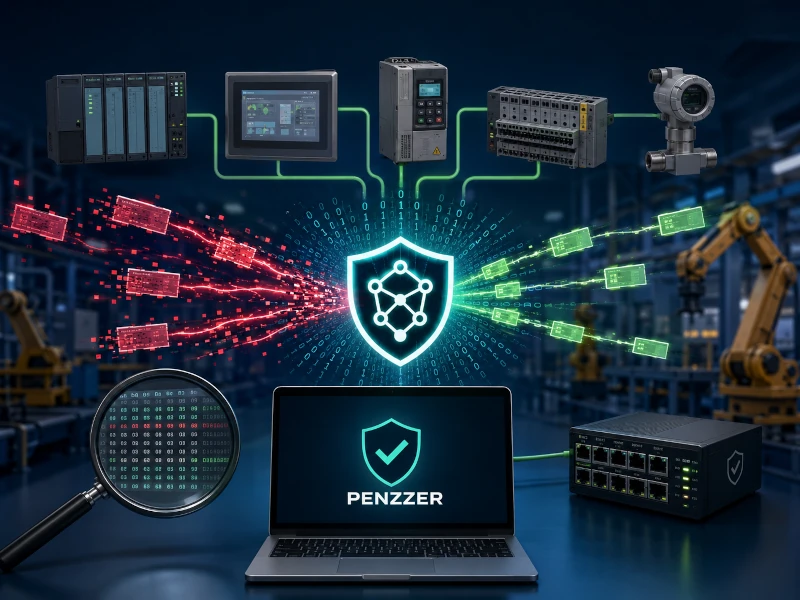
IEC 62443 defines comprehensive industrial cybersecurity requirements. Robustness, negative testing, and vulnerability discovery are essential, and fuzzing with Penzzer helps developers and integrators meet these expectations and improve overall system resilience.

IEC 62443 is widely recognized as the foundational international standard for industrial cybersecurity, and its influence has grown steadily as industrial automation and control systems have converged with information technology networks. The standard provides a comprehensive, lifecycle-oriented framework designed to secure industrial environments, which include programmable logic controllers, distributed control systems, safety instrumented systems, remote terminal units, intelligent sensors, fieldbus gateways, human-machine interfaces, industrial network gear, and supervisory systems. These environments differ substantially from traditional IT systems: they often must operate around the clock, they manage physical processes that can directly endanger human life, and they rely on legacy protocols or long-lived hardware. Therefore, IEC 62443 attempts to strike a delicate balance between contemporary cybersecurity principles and constraints imposed by industrial operations, safety requirements, and cost structures. Although the standard never explicitly uses the term fuzzing, many of its technical and process requirements implicitly demand robust, automated testing approaches such as fuzz testing. As a result, modern fuzzing platforms like Penzzer naturally align with the goals and mandates of the standard.

To understand how fuzzing integrates with IEC 62443, it is necessary to explore the origins, intent, and structure of the standard. The series began as ISA-99, initiated by the International Society of Automation to address escalating cyber risks to industrial control systems. Over time, the standard was adopted and formalized by the International Electrotechnical Commission, which expanded its scope and harmonized its terminology with global regulatory expectations. Its purpose is not merely to prescribe a list of controls, but rather to create a flexible, repeatable framework that manufacturers, integrators, asset owners, and service providers can adopt regardless of their size, industry, or technology stack. IEC 62443 recognizes that cybersecurity in industrial settings requires cooperation among participants at multiple levels: the component developers who write firmware and implement protocol stacks; the integrators who assemble components into larger systems; the asset owners who operate the systems; and the service providers who maintain and support them. Because failures can cascade across these layers, the standard defines requirements for each role.

The structure of the standard is divided into four major groups. The first group establishes general concepts, terminology, and models. The second group provides requirements for organizational policies and procedures, guiding asset owners on how to manage cybersecurity programs, inventories, patching, and supplier relationships. The third group focuses on system-level security requirements and architectural considerations, including risk assessment, segmentation through zones and conduits, and allocation of security levels across systems. The fourth group is tailored specifically to product developers and component manufacturers. It includes the secure development lifecycle and detailed component requirements for embedded devices, network components, host applications, and sensors and actuators. Across these groups, IEC 62443 introduces central concepts such as zones and conduits, which define how industrial assets should be segmented and interconnected. A zone is a group of assets with common security requirements, while a conduit is a secure pathway that connects zones, controlling the flow of data between them. This architecture supports defense in depth by reducing the blast radius of potential attacks.

Another central concept is the notion of security levels. IEC 62443 defines four levels, ranging from protection against unintended misuse or casual violation to protection against highly skilled and well-resourced attackers. These levels represent increasing maturity in the security posture of a system or component. They are not merely checklists but measurable targets for defense objectives. The standard defines numerous foundational requirements, such as identification and authentication control, use control, system integrity, data confidentiality, restricted data flow, timely response to events, and resource availability. Each of these foundational requirements contains detailed security requirements that can be applied at the system or component level and mapped to target security levels.

Understanding how fuzzing fits into this landscape requires examining how industrial systems fail and what types of vulnerabilities are most prevalent. Throughout the history of industrial cybersecurity, many of the most severe vulnerabilities have originated from improper handling of input: malformed protocol messages, oversized packets, invalid states within communication exchanges, corrupted or partially-complete configuration files, unexpected data types, and logic inconsistencies triggered by edge-case state transitions. Industrial protocols, unlike many modern IT protocols, often lack inherent security features. They were designed decades ago for isolated operational environments, not network-connected infrastructures exposed to remote attackers. As a result, their implementations are frequently fragile when subjected to malformed input or unexpected communication sequences.

Fuzz testing has historically proven to be one of the most effective methods for discovering such vulnerabilities. Numerous industrial-sector vulnerabilities documented over the last 15 years were discovered through fuzzing: gateway devices that crash from oversized Modbus packets; protocol parsers in PLCs that mishandle unexpected function codes; SCADA HMIs that load configuration files in unsafe ways; embedded control devices that fail to release memory after repeated communication requests, leading to resource exhaustion; OPC UA servers that mismanage session token expiration logic. Fuzzing is not limited to identifying memory corruption; it also reveals logic flaws, race conditions, protocol-state inconsistencies, and undefined behavior triggered by semi-structured input. These issues directly map to the system integrity and resource availability requirements of IEC 62443.

Given this context, fuzzing is not a mere best practice-it is a direct and necessary means of meeting the intent of the standard. Even though IEC 62443 avoids prescribing specific testing tools, it repeatedly emphasizes the need for robustness testing, negative testing, dynamic analysis, vulnerability identification, and verification of secure coding practices. These are the core pillars of modern fuzzing. Therefore, a platform like Penzzer provides substantial assistance to developers, integrators, and asset owners seeking compliance.

To understand this relationship, it helps to look closely at how various parts of IEC 62443 define requirements that fuzzing naturally satisfies. Consider IEC 62443-4-1, the secure product development lifecycle. This part defines eight practices: establishing security requirements, designing securely, implementing securely, performing verification and validation, managing defects, handling security updates, producing security guidelines, and generating appropriate documentation. Verification and validation expectations include performing negative testing, robustness testing, dynamic testing, vulnerability identification, and regression testing after remediation. These requirements effectively mandate the use of automated, repeatable methods that challenge components with malformed or adversarial input. Penzzer directly supports this by enabling continuous, automated fuzzing campaigns that run throughout development and into CI pipelines. When a developer commits code changes, Penzzer can automatically launch fuzzing jobs, observe coverage increases, discover crashes, and generate minimal reproducing inputs, complete with stack traces, logs, and triage data. This directly satisfies the validation expectations within IEC 62443-4-1.

Moreover, the standard requires secure implementation practices, including avoidance of memory-unsafe constructs or proper mitigation around them. Fuzzing through Penzzer will reveal memory problems such as buffer overflows, use-after-free bugs, null dereferences, and invalid pointer accesses that violate these principles. Because Penzzer supports integration with sanitization technologies such as AddressSanitizer or undefined behavior sanitizers, it can produce precise insights into memory-allocation paths and undefined behavior, helping developers eliminate violations early in the lifecycle.

Another relevant requirement within 62443-4-1 involves defect management. When security vulnerabilities are identified, they must be documented, triaged, resolved, tested, and verified. Penzzer automates much of this cycle. It generates reproducible artifacts: test cases that triggered crashes, the command-line invocation needed to reproduce the failure, and full trace data. Once developers implement fixes, regression fuzzing ensures that the same issues do not reappear-an important requirement because industrial environments often reuse libraries or components across products.

IEC 62443-4-2 defines technical security requirements for components such as embedded devices, network devices, host applications, and sensors. Many of these map even more directly to fuzzing. For example, requirements concerning malicious input handling, session-handling integrity, communication-channel robustness, exception management, resource-availability guarantees, and protection from malformed protocols all correlate directly with outcomes that fuzz testing reveals. If a PLC firmware's protocol stack fails when receiving random payloads, the device violates requirements for system integrity. If an HMI crashes after receiving malformed configuration files, the device violates foundational requirements relating to resource availability and robustness. Penzzer's capability to fuzz protocol handlers, file parsers, binary data formats, or custom proprietary message structures allows component manufacturers to validate compliance with these expectations.

Another important part of the standard, IEC 62443-3-3, defines system security requirements. While this part focuses on system integrators rather than component developers, fuzzing still plays a central role. System integrators must ensure that the communication paths between zones (conduits) behave predictably under adversarial conditions. For example, a firewall or industrial gateway must not crash when receiving malformed packets. A protocol translator must not become stuck in abnormal states that lead to denial-of-service conditions. Session-oriented systems such as OPC UA or MQTT brokers must safely handle abnormal authentication or handshake patterns. Penzzer provides a means for integrators to test the robustness of these system-level interactions. By fuzzing traffic that traverses conduits, integrators can certify that zone boundary protections behave correctly.

IEC 62443-3-2 concerns risk assessment and system design. Although fuzzing is not explicitly part of risk assessment, it informs risk assessment by revealing attack surfaces and vulnerabilities that may not be visible during architectural analysis. Often, developers or integrators assume that certain inputs are well-formed or that particular states cannot occur. Fuzzing disproves such assumptions, providing empirical evidence about component robustness. This evidence feeds into the risk assessment, demonstrating whether a component can withstand adversarial conditions or whether additional mitigations are needed.

Beyond specific component or system requirements, IEC 62443 requires organizations to manage cybersecurity programs, maintain inventories, patch components securely, and manage supplier relationships. These aspects may seem distant from fuzz testing. However, Penzzer assists indirectly by enabling suppliers to demonstrate testing rigor. Many asset owners require suppliers to document their secure development practices or provide evidence of robustness testing. A fuzzing tool like Penzzer allows suppliers to generate detailed test reports, metrics, logs, and reproducible artifacts that can serve as audit evidence. This strengthens supplier trust and enables integrators and asset owners to purchase products more confidently.

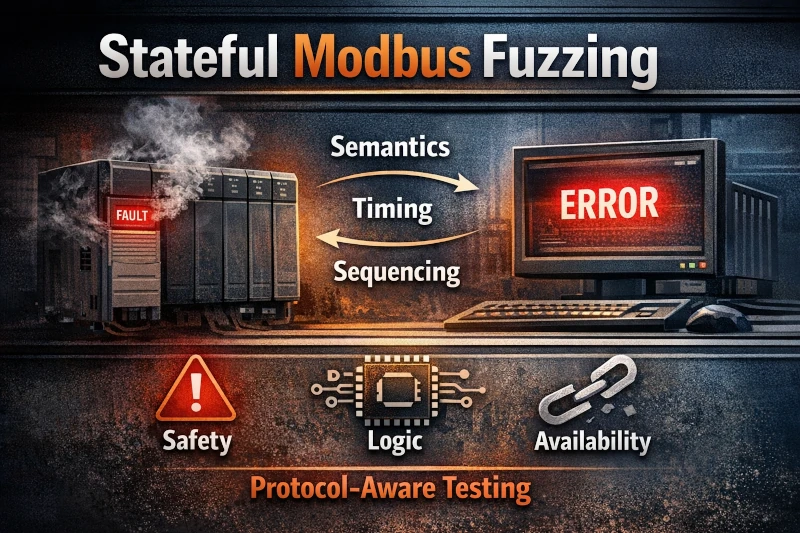
The usefulness of Penzzer within the IEC 62443 framework becomes even more apparent when examining specific examples. Consider industrial protocols such as Modbus, DNP3, Profinet, EtherNet/IP, BACnet, MMS, and OPC UA. These protocols are ubiquitous in industrial systems, and their implementations vary across vendors. Many vulnerabilities disclosed over the years have originated from protocol parser issues. Penzzer can target these implementations by generating structured or semi-structured messages, mutating fields, and exploring state machine inconsistencies. It can do this through stateless fuzzing, where each test case is an independent packet, or through stateful fuzzing, where sequences of messages are constructed to mimic realistic interactions while probing edge cases.

In embedded device firmware, memory safety remains a recurring concern because of the prevalence of C and C++ code. Penzzer, equipped with coverage-guided and sanitization-enhanced fuzzing, exposes memory corruption issues efficiently. Whether the software is running in a containerized emulator, a hardware-in-the-loop setup, or a dedicated test harness, Penzzer can generate malformed inputs that reveal potential catastrophic failures. Eliminating these failures helps organizations satisfy security-level requirements that demand protection against unintended or intentional misuse.

File format fuzzing is another key application. Industrial systems process configuration files, project archives, ladder logic files, and binary representations of settings and firmware updates. These formats often contain complex structures, version-dependent fields, and variable-length sections that developers may handle incorrectly. A single malformed project file can prevent an HMI from starting, cause a PLC programming tool to misbehave, or even trigger unwanted writes to persistent storage. Penzzer enables fuzzing of these formats, either by mutating existing files or generating files from format descriptions. Testing the resilience of file parsers ensures compliance with requirements concerning resource availability, error handling, and robustness.

Stateful systems such as OPC UA servers or complex industrial gateways benefit particularly from fuzzing because many vulnerabilities arise from flawed state transitions. For example, an OPC UA server might mishandle authentication token expiration, or a gateway might accept unexpected sequences of messages that lead to denial-of-service or authentication bypass conditions. Stateful fuzzing allows Penzzer to construct multi-step interactions where each stage influences the next, thereby testing deeper corner cases that would not be exposed by simple one-shot fuzzing.

The value of fuzzing also lies in its ability to exceed the baseline expectations of the standard. IEC 62443 is intentionally conservative; it outlines practices that provide a strong foundation but does not attempt to cover every possible attack technique. Attacks evolve faster than standards can be updated. Fuzzing addresses emerging unknowns by discovering vulnerabilities that developers did not anticipate and that the standard does not explicitly describe. A device that merely meets the requirements of IEC 62443 may still contain exploitable flaws unless robust testing techniques are used. Fuzzing elevates the maturity of secure development beyond mere compliance.

Compliance with IEC 62443 presents challenges, many of which relate to testing and validation. Development teams often struggle with the requirement for negative testing, which demands that systems behave correctly even when presented with malformed inputs. Manual negative testing is tedious, error-prone, and limited in scope. Penzzer automates negative testing at scale, running millions of test cases across distributed infrastructure. Teams also face difficulty maintaining testing rigor across frequent code changes. Penzzer's continuous integration capabilities allow fuzz tests to run automatically with every commit, alerting teams to regressions or newly introduced vulnerabilities.

Another common challenge involves generating documentation for audits. Regulators, certification bodies, and asset owners often require evidence of testing. Penzzer automatically produces logs, metrics, coverage reports, and crash artifacts that teams can include in certification submissions. This satisfies the requirement for traceability of testing activities.

Furthermore, industrial software frequently interacts with hardware components, making testing difficult. Penzzer supports emulated environments, containerized test harnesses, and integration with hardware testbeds. This flexibility allows developers working on embedded firmware or network appliances to perform fuzz testing even when physical hardware is scarce or expensive.

As a whole, fuzzing with Penzzer provides not only a pathway to meeting IEC 62443 requirements but a means of enhancing security beyond the standard's minimum expectations. The combination of automated robustness testing, vulnerability identification, and continuous improvement aligns naturally with the standard's lifecycle approach. Manufacturers and developers who adopt fuzzing early in the development lifecycle benefit from reduced long-term maintenance costs, fewer field-discovered vulnerabilities, and stronger trust with customers and integrators.

IEC 62443 aims to create a shared foundation for security across the industrial ecosystem. Fuzz testing strengthens that foundation by exposing weaknesses that would remain invisible through conventional testing. The history of industrial cybersecurity repeatedly demonstrates that attackers do not simply follow predefined paths; instead, they exploit unexpected behaviors triggered by malformed or adversarial input. Fuzzing reveals these unexpected behaviors before attackers discover them.

The future of industrial cybersecurity will involve greater connectivity, increased use of cloud-based supervisory systems, and more complex interactions among automated components. This complexity will expand the space of possible input conditions and edge cases. Traditional testing approaches cannot keep up with this expansion. In contrast, fuzzing is inherently well-suited to exploring vast input spaces and uncovering edge cases that developers may have never imagined. Platforms like Penzzer, which combine coverage guidance, stateful testing, cloud scalability, and automated triage, represent a crucial contribution to the ongoing effort to secure industrial systems.

As organizations adopt IEC 62443 and pursue certification, they face the challenge of demonstrating that products and systems behave robustly under unpredictable conditions. Penzzer provides measurable, reproducible evidence of robustness. It discovers vulnerabilities earlier, enables efficient triage, supports regression testing, and integrates seamlessly with secure development workflows. By doing so, it directly supports compliance with the intent and the letter of IEC 62443 while elevating security beyond compliance alone. The convergence of standards, best practices, and advanced automated testing ensures that industrial systems become more resilient, safer, and capable of withstanding both accidental failures and deliberate attacks. This alignment between the principles of IEC 62443 and the capabilities of modern fuzzing platforms is not coincidental; it reflects the practical necessity of rigorous testing in increasingly complex industrial environments. The result is a safer industrial ecosystem where systems are not only compliant on paper but robust in reality, and where unseen vulnerabilities are discovered by defenders long before they can be exploited in the field.

Other Post
Uncover Hidden Vulnerabilities

Identify security flaws before attackers do, automatically and at scale with Penzzer's intelligent fuzzing engine.

Thank you! Your submission has been received!
Oops! Something went wrong while submitting the form.