
Bluetooth Low Energy GATT Fuzzing

Stateful BLE GATT fuzzing reveals real-world vulnerabilities by exercising valid, time-dependent workflows; Penzzer enables semantic, temporal, black-box campaigns that expose logic, reliability, and resource-management failures beyond packet mutation.

BLE Architecture Refresher (Concise, Exact)

Bluetooth Low Energy is often described as a layered stack, but for fuzzing purposes the more accurate mental model is a set of tightly coupled state machines operating under severe timing, memory, and power constraints. At the bottom, the physical layer and link layer handle modulation, channel hopping, connection intervals, supervision timeouts, and retransmissions. These layers already impose nontrivial constraints on fuzzing: packets are short, timing is strict, and transient RF failures are indistinguishable from certain classes of software faults.

Above the link layer sits L2CAP, which in BLE is reduced to a lightweight multiplexing and fragmentation layer. Its primary relevance to fuzzing is the segmentation and reassembly of higher-layer PDUs, particularly when the negotiated MTU exceeds the default 23 bytes. Incorrect handling of L2CAP fragmentation, offsets, and reassembly buffers remains a common source of memory corruption and logic errors in embedded stacks.

The Attribute Protocol (ATT) provides the request/response semantics that most fuzzers interact with directly. ATT defines a small set of operations, read, write, write without response, prepare write, execute write, find information, read by type, read by group type, and error responses, each operating on attribute handles. Handles are 16-bit integers that index into a server-side attribute table. They are opaque to the client but semantically meaningful to the server: ordering matters, ranges matter, and off-by-one errors often map to real memory or logic faults.

On top of ATT sits the Generic Attribute Profile (GATT), which defines how attributes are grouped into services, characteristics, and descriptors. A characteristic is not a single attribute but a structured sequence: a characteristic declaration, a characteristic value, and zero or more descriptors. Client Characteristic Configuration Descriptors (CCCDs) are particularly important, as they maintain per-connection or per-bond state controlling notifications and indications. Mismanagement of CCCD state, especially across reconnections or role changes, is a frequent source of subtle bugs.

MTU negotiation is a first-class concern. The ATT MTU determines the maximum payload size for most operations and directly affects fragmentation behavior, offset calculations for long reads and writes, and internal buffer allocation. Many embedded implementations assume a narrow MTU range, and failures often occur when MTU renegotiation is combined with long writes or notifications.

Notifications and indications introduce asynchronous behavior into an otherwise request/response protocol. Once enabled, the server may transmit data without a corresponding client request, subject to flow control constraints. Indications require acknowledgments; notifications do not. The distinction matters when fuzzing timing and backpressure behavior.

Finally, connection state in BLE is long-lived and layered. Pairing state, bonding keys, negotiated MTU, enabled notifications, cached attribute handles, and application-specific session state may all persist across minutes, hours, or reconnections. For fuzzing, this means that many vulnerabilities are not reachable in a single interaction but emerge only after specific sequences of valid operations executed over time.

Threat Model for GATT-Exposed Devices

A realistic threat model for GATT fuzzing starts with proximity. BLE is fundamentally a short-range protocol, but proximity does not imply triviality. Attackers may have extended dwell time near a target device, may return repeatedly, and may operate from commodity hardware capable of acting as a central, a peripheral, or both.

Pairing and bonding states significantly affect attack surface. Many devices expose a substantial subset of their GATT surface prior to pairing, either intentionally or due to misconfiguration. Even when pairing is enforced, legacy pairing modes, Just Works associations, or poorly managed bonding databases can allow unauthorized access or state confusion. Bonded devices introduce persistence: keys, CCCD state, and application flags may be restored after reboot, sometimes incorrectly.

Man-in-the-middle capability is often dismissed due to BLE's use of link-layer encryption, but in practice MITM is feasible in several scenarios: during initial pairing, when legacy pairing modes are used, or when devices allow role switching. Some embedded devices also implement both central and peripheral roles, exposing complex interaction patterns that are rarely tested.

From an impact perspective, GATT-exposed vulnerabilities often manifest as availability and reliability failures before they become obvious integrity or confidentiality issues. Resource exhaustion, watchdog resets, deadlocks, and state desynchronization can render a device unresponsive or unsafe, particularly in systems that interact with physical processes. Even when the data carried over GATT appears low-risk, the code paths handling it may control actuators, firmware update mechanisms, or safety interlocks.

Importantly, many of these impacts arise not from malformed packets but from valid, standards-compliant interactions executed in unexpected sequences or at unexpected rates. This observation fundamentally shapes how GATT fuzzing must be approached.

Why Traditional Fuzzing Fails for GATT

Most traditional fuzzing techniques assume a stateless or weakly stateful target. Packet mutation fuzzers excel at discovering parsing errors in protocols where individual messages are largely independent. GATT does not fit this model.

First, GATT is stateful by design. Handles are discovered dynamically. MTU is negotiated. CCCDs maintain subscription state. Long writes require a prepare/execute sequence. Many operations are only valid in specific phases of a connection. A stateless fuzzer that sends random ATT PDUs without respecting these dependencies will be rejected early by the stack and will never reach deeper logic.

Second, much of the interesting logic sits above ATT. Application code frequently assumes that requests arrive in “reasonable” sequences: reads after discovery, writes after configuration, notifications only when enabled. Violating these assumptions with valid but atypical sequences is where many bugs live. Packet-only fuzzers lack the semantic awareness to construct such sequences.

Third, temporal coupling matters. Timing between requests, delays between prepare and execute, bursts of notifications, or renegotiation of MTU mid-session can all expose race conditions or resource leaks. These behaviors are invisible to fuzzers that treat inputs as isolated packets.

Finally, generic BLE tooling often optimizes for correctness and interoperability, not adversarial exploration. It caches handles, retries politely, and avoids stressing edge cases. While invaluable for development, such tooling actively suppresses the behaviors most likely to reveal vulnerabilities.

A Rigorous Methodology for BLE GATT Fuzzing

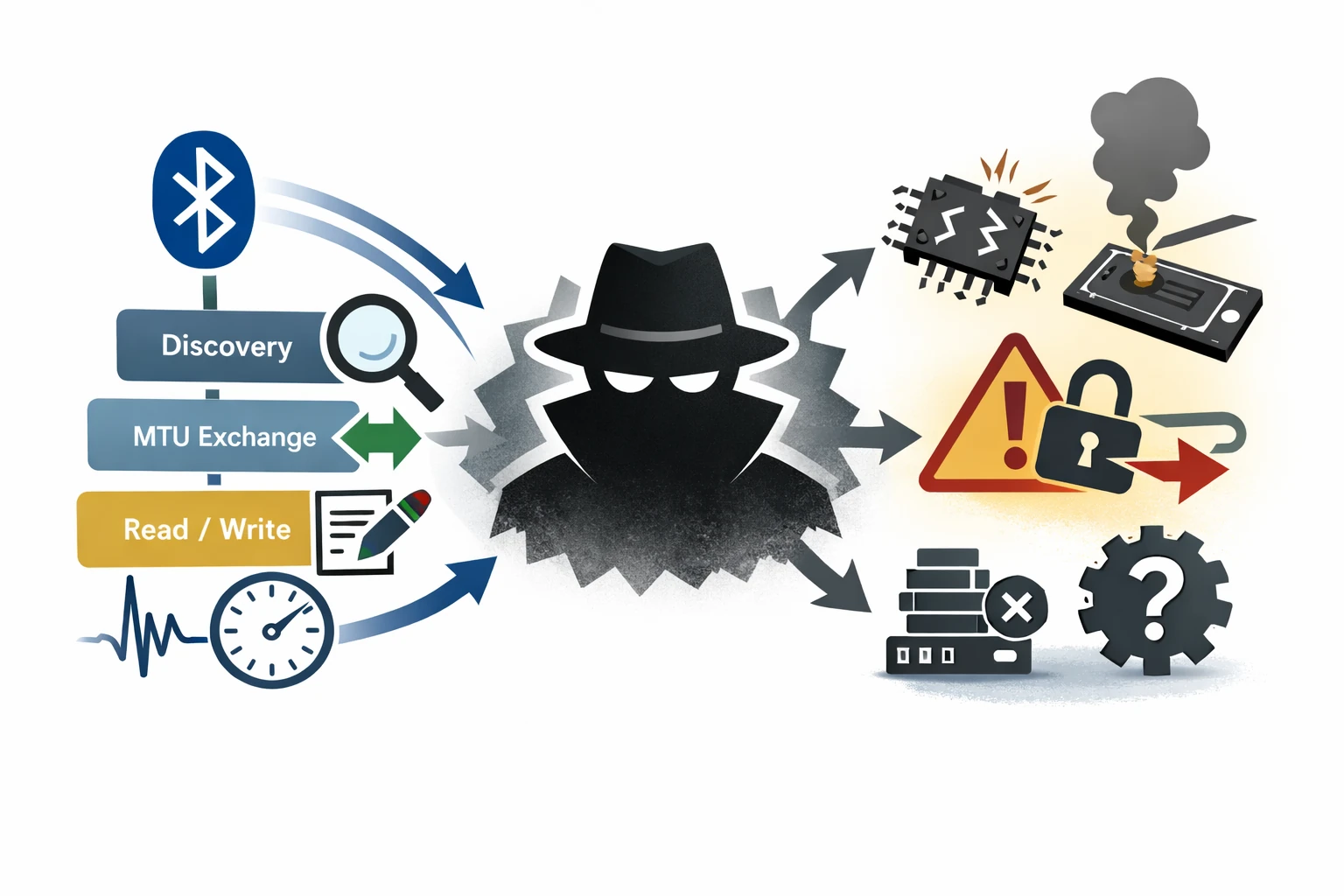
Effective GATT fuzzing requires a methodology that treats the protocol as a set of interacting workflows rather than a flat message space. The first step is explicit modeling of these workflows. A typical baseline sequence might include connection establishment, service and characteristic discovery, MTU exchange, CCCD configuration, and steady-state read/write or notification cycles. Each of these phases introduces state that influences subsequent behavior.

State tracking is essential. The fuzzer must maintain a model of negotiated parameters (such as MTU), discovered handle ranges, enabled descriptors, and application-visible state inferred from responses. This model need not be perfect, but it must be sufficient to generate both valid and intentionally borderline interactions.

Semantic boundary exploration is more valuable than raw mutation. For GATT, this includes boundary lengths for characteristic values, offset handling in long reads and writes, permission mismatches (for example, attempting writes where only reads are expected), and manipulation of CCCDs in unusual orders. The goal is to remain within the protocol’s formal validity while violating the developer's implicit assumptions.

Sequencing and reordering attacks are a core technique. Examples include executing a write without prior prepare, reusing prepare write buffers across characteristics, toggling CCCDs rapidly, or interleaving discovery with data access. Each sequence is valid in isolation, but their composition stresses state management logic.

Temporal fuzzing adds another dimension. Delays between requests can trigger timeouts or cleanup paths. Bursts can overwhelm queues. Renegotiating MTU after enabling notifications can force reallocation of buffers under load. These scenarios are difficult to reach without explicit timing control.

Crucially, this methodology assumes long-running sessions. Many failures only emerge after minutes or hours of interaction, as counters overflow, memory fragments, or state machines drift. A rigorous GATT fuzzer must therefore support sustained operation with evolving state.

Using Penzzer in Practice

Applying this methodology in practice requires a framework capable of modeling state, sequencing interactions, and manipulating timing. Penzzer is designed around these requirements and can be used as the execution engine for stateful GATT fuzzing campaigns.

A typical testbed consists of one or more BLE adapters capable of acting as a central. The choice of hardware matters: adapters must support stable connections, flexible MTU negotiation, and reliable timing control. The operating system must expose sufficient control over BLE roles and parameters; Linux-based setups are common due to their flexibility.

The first operational step is mapping the target’s GATT surface. This involves controlled discovery of services, characteristics, and descriptors, recording handle ranges and permissions. Rather than caching this information statically, Penzzer treats it as part of the mutable state: rediscovery may be triggered at arbitrary points to test consistency and caching behavior on the target.

Modeling follows mapping. Each characteristic and descriptor becomes an object with associated operations, constraints, and inferred semantics. For example, a writable characteristic with a maximum observed length can be subjected to boundary exploration around that length, combined with offset-based access patterns if long writes are supported.

Stateful fuzzing campaigns are then constructed as sequences of actions rather than individual packets. An action might represent "write characteristic X with payload Y," but its execution is conditioned on current state: MTU size, connection phase, CCCD settings, and prior actions. Penzzer allows these actions to be composed, reordered, repeated, or interleaved in controlled ways.

Temporal fuzzing is implemented by varying delays between actions, batching operations, or triggering renegotiation events mid-sequence. For example, a campaign might enable notifications, induce a burst of notifications from the server, renegotiate MTU, and then issue long writes, observing how the device copes with concurrent demands.

In black-box operation, feedback is necessarily indirect. Penzzer monitors connection stability, response timing, error codes, and unexpected behavior such as silent stalls or repeated disconnects. External signals - such as device resets, watchdog-triggered reboots, or changes in advertisement behavior - are also incorporated. While this feedback lacks the granularity of in-process instrumentation, it is often sufficient to identify anomalous states worth deeper investigation.

Scaling campaigns involves managing state explosion. Penzzer supports corpus management at the level of action sequences, allowing effective paths to be retained and mutated while unproductive ones are pruned. Findings are triaged by reproducibility: sequences that reliably induce failures are isolated, minimized, and documented for further analysis.

Failure Classes and Case Patterns

Experience with GATT fuzzing reveals several recurring classes of failure. Parsing errors remain common, particularly in handling long writes and fragmented PDUs. These often manifest as crashes or resets when offset calculations or buffer lengths are mishandled.

Permission bypasses arise when application logic assumes that certain operations cannot occur without prior configuration. For example, writing to a characteristic before pairing may succeed due to inconsistent enforcement between ATT permissions and higher-level checks.

State desynchronization is a particularly insidious class. The server and client may disagree about CCCD state, MTU size, or transaction progress, leading to undefined behavior. These issues often only appear after reconnection or role changes, highlighting the importance of persistent state fuzzing.

Resource exhaustion is frequently exposed through notification storms, repeated prepare writes without execution, or rapid connect/disconnect cycles. Embedded devices with limited memory and simplistic cleanup logic are especially vulnerable.

Finally, logic faults triggered by valid but unexpected sequences are arguably the most valuable findings. These include enabling notifications before discovery completes, renegotiating MTU during active data transfer, or mixing operations across characteristics in ways the developer did not anticipate. Such bugs are difficult to detect with traditional testing but can have severe reliability or safety implications.

Operational Considerations

Conducting GATT fuzzing in real environments introduces practical challenges. Reproducibility is complicated by RF variability, background interference, and nondeterministic scheduling in embedded systems. Mitigation strategies include controlled RF environments, repeated execution of candidate sequences, and careful logging of timing and state.

Safety controls are essential, particularly when fuzzing devices connected to physical systems. Test isolation, use of simulators or sacrificial hardware, and strict power and watchdog monitoring reduce risk.

Watchdogs and brownouts complicate analysis. A reset may indicate a genuine fault or a defensive recovery mechanism. Distinguishing between the two requires correlation with prior actions and, where possible, external observation such as power consumption or debug interfaces.

Responsible disclosure remains a critical aspect. Stateful GATT vulnerabilities are often subtle and require clear reproduction steps. Preserving minimized action sequences and precise timing information greatly improves the quality of reports and the likelihood of successful remediation.

Synthesis and Forward-Looking Insights

BLE GATT fuzzing exposes a fundamental truth about modern embedded protocols: the most serious failures rarely arise from malformed inputs alone. They emerge from the interaction of valid operations, persistent state, and time. GATT’s design - dynamic discovery, negotiated parameters, asynchronous notifications, and long-lived connections—creates a fertile environment for such failures.

Stateful, semantic, and temporal fuzzing aligns naturally with these realities. By modeling workflows, tracking evolving state, and deliberately exploring edge-case sequences over time, fuzzers can reach code paths that remain invisible to traditional approaches.

Using Penzzer as an execution framework enables this style of analysis in practice. Its emphasis on stateful campaigns, timing control, and black-box feedback allows researchers to interrogate real devices under realistic conditions. The result is not merely a higher volume of findings, but a qualitatively different class of vulnerabilities—those rooted in logic, reliability, and long-term behavior.

As BLE continues to be adopted in increasingly critical systems, the importance of such approaches will only grow. GATT fuzzing, when treated as workflow interrogation rather than packet mutation, becomes a powerful tool for understanding and improving the resilience of embedded devices in the field.

Other Post
Uncover Hidden Vulnerabilities

Identify security flaws before attackers do, automatically and at scale with Penzzer's intelligent fuzzing engine.

Thank you! Your submission has been received!
Oops! Something went wrong while submitting the form.