
How to Fuzz-Test Modbus Masters and PLC Devices

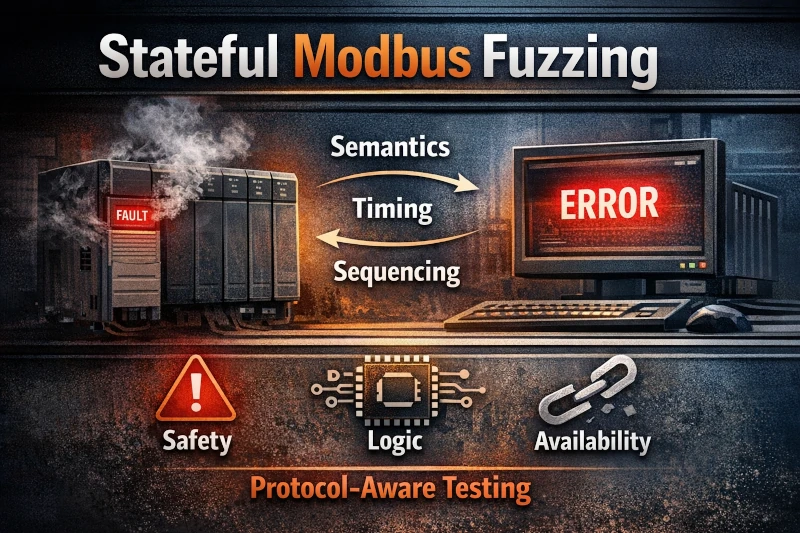
Stateful Modbus fuzzing exposes real-world PLC and master failures by abusing valid protocol semantics, timing, and sequencing; protocol-aware tools like Penzzer reveal safety, logic, and availability faults invisible to stateless testing.

Modbus in Real-World ICS Environments

Modbus persists in modern industrial control systems not because it is adequate, but because it is ubiquitous, simple, and deeply embedded into operational assumptions that no longer hold. In live environments, Modbus is rarely an isolated protocol instance. It is a control-plane mechanism entangled with PLC scan cycles, I/O refresh logic, safety interlocks, supervisory HMIs, historians, protocol gateways, and sometimes cloud-connected analytics layers. Any attempt to fuzz Modbus meaningfully must therefore treat it as an operational protocol, not a wire format.

RTU vs TCP: behavioral divergence under load

Although Modbus RTU and Modbus TCP share function codes and register semantics, their runtime behavior diverges significantly once placed under adversarial conditions.

Modbus RTU is serialized, timing-sensitive, and bounded by line discipline. Frame gaps, inter-character timing, and master polling cadence implicitly regulate request concurrency. Many PLC RTU stacks assume:

  • One outstanding request at a time
  • Deterministic request ordering
  • Tight coupling between request reception and scan-cycle execution

Violating these assumptions - by compressing inter-frame timing, replaying late responses, or interleaving diagnostic functions - can induce undefined behavior even without malformed frames.

Modbus TCP, by contrast, removes most physical constraints. Transaction identifiers allow multiplexing; TCP allows pipelining; gateways may aggregate multiple logical masters behind a single IP. Many PLC TCP stacks, however, are thin adaptations of RTU logic, retaining single-threaded or partially reentrant handlers. The result is a protocol that appears stateless and request/response-oriented but is actually dependent on implicit sequencing, pacing, and resource assumptions.

Master–slave trust assumptions

In deployed systems, Modbus masters are not passive. They encode logic:

  • Periodic polling strategies
  • Write-after-read workflows
  • Confirmation by readback
  • Implicit safety invariants (e.g., “coil X is only written after register Y indicates READY”)

PLC devices, conversely, often trust the master to behave "correctly":

  • Function codes are assumed to arrive in operationally valid order
  • Address ranges are assumed to map to coherent internal structures
  • Write requests are assumed to reflect legitimate control intent

This bidirectional trust is rarely enforced in code. It exists as tribal knowledge and system-level design intent, not as protocol-level validation. Stateful fuzzing exploits precisely this gap.

PLC scan cycles and protocol coupling

A PLC scan cycle typically proceeds as:

  1. Input image update
  2. Logic execution
  3. Output image update
  4. Housekeeping (communications, diagnostics, watchdog servicing)

In many implementations, Modbus handling is interleaved with or gated by scan-cycle phases. For example:

  • Writes to holding registers may be buffered until the next logic execution phase
  • Certain function codes may block until I/O refresh completes
  • Diagnostic or encapsulated functions may run in lower-priority contexts

A fuzzer that does not align request timing with scan-cycle boundaries will miss entire classes of faults: stale state application, race conditions between I/O and logic, and watchdog starvation scenarios.

Simplicity as a systemic hazard

Modbus's minimalism is often cited as a virtue. In practice, it shifts complexity upward:

  • Register maps encode dense, undocumented semantics
  • Safety logic is implemented out-of-band
  • Error handling is inconsistent and vendor-specific

At scale - across thousands of registers, multiple masters, gateways, and safety overlays - this simplicity becomes a liability. Stateful fuzzing is one of the few techniques capable of surfacing how these layers fail together.

Modbus Attack Surface Beyond "Malformed Packets"

Most real Modbus vulnerabilities do not arise from invalid frames. They arise from valid requests used adversarially.

Function-code semantics as attack primitives

Consider the standard function codes:

  • Read Coils / Discrete Inputs
  • Read Holding / Input Registers
  • Write Single / Multiple Coils
  • Write Single / Multiple Registers
  • Diagnostics (08)
  • Encapsulated Interface Transport (43/14)

Each function code is semantically meaningful. Their effects depend on:

  • Register address ranges
  • Current PLC internal state
  • Recent protocol history

For example, a Write Multiple Registers request that spans a boundary between configuration registers and runtime state may be syntactically valid but semantically catastrophic. Similarly, diagnostic subfunctions can reset counters, clear logs, or alter communication behavior - often without authentication or rate limiting.

Vendor-specific register maps

Real PLC register maps are not flat arrays. They encode:

  • Shadow copies of I/O images
  • Configuration structures
  • Calibration constants
  • Safety thresholds
  • Firmware feature flags

Boundary assumptions are common. Developers assume that "no one will ever write past register X" or that "these registers are only touched during commissioning." Fuzzing that systematically explores boundary crossings, partial writes, and interleaved read/write cycles exposes logic corruption that never manifests under normal operation.

Timing, concurrency, and interleaving

Modbus TCP allows multiple outstanding requests. Many masters exploit this for performance. Many PLCs are not designed for it.

Interleaving patterns that matter include:

  • Read requests overlapping long-running write handlers
  • Diagnostic functions invoked mid-transaction
  • Replayed transaction identifiers with altered payloads
  • Rapid alternation between configuration and control registers

These patterns do not violate the protocol. They violate assumptions.

Master-side vulnerabilities

Masters are often more fragile than PLCs:

  • HMIs assume monotonic register updates
  • Historians assume type stability
  • Gateways assume fixed register semantics

Fuzzing that targets master behavior - by acting as a malicious PLC or intermediary - can induce memory corruption, logic lock-ups, or silent data poisoning upstream. This is often overlooked in PLC-centric testing.

Why Naive Modbus Fuzzing Fails

Stateless mutation is blind to meaning

Bit-flipping function codes or randomizing payload lengths rarely triggers meaningful faults. Most Modbus stacks reject malformed frames early or ignore nonsensical requests. The interesting failures lie behind layers of semantic validity.

Packet-level fuzzing misses temporal faults

Traditional fuzzers treat each input independently. Modbus failures are often temporal:

  • A write is dangerous only after a specific read
  • A diagnostic reset is harmful only during active control
  • A boundary violation matters only after configuration state is partially applied

Without session memory, these conditions never materialize.

Coverage without observability is misleading

Even if a fuzzer "covers" all function codes, it may never observe:

  • Partial state application
  • Deferred crashes
  • Watchdog resets minutes later
  • Master desynchronization that persists silently

Effective Modbus fuzzing requires correlating protocol actions with operational signals: PLC state, master behavior, network side effects, and physical I/O changes.

Vulnerability Classes Revealed by Modbus Fuzzing

PLC crashes and watchdog resets

Stateful sequences can:

  • Starve watchdog servicing by overloading communication handlers
  • Trigger assertion failures in rarely used code paths
  • Exhaust internal queues or buffers without violating protocol limits

These often manifest as delayed resets rather than immediate faults.

Logic corruption and unsafe state transitions

Examples include:

  • Partial writes to multi-register structures
  • Interruption of configuration updates mid-cycle
  • Overwriting calibration data with operational values

The PLC may continue running - incorrectly.

Master-side failures

HMIs and gateways may:

  • Crash on unexpected value transitions
  • Enter infinite retry loops
  • Display stale or contradictory data

These failures can propagate operational risk even if the PLC remains functional.

Availability, integrity, and safety impacts

The most severe outcomes are not crashes but misbehavior:

  • Outputs driven to unsafe states
  • Safety interlocks bypassed due to inconsistent register state
  • Operators misled by falsified telemetry

These are precisely the failures that compliance checklists and CVE databases fail to capture.

Stateful Modbus Fuzzing Methodology

Session-aware sequencing

A fuzzer must model:

  • Logical sessions (even in TCP)
  • Transaction identifier reuse
  • Master polling cycles

State is not negotiated explicitly; it is inferred from behavior.

Function-code choreography

Effective campaigns deliberately orchestrate function codes:

  • Read → Write → Readback loops
  • Configuration writes interleaved with diagnostics
  • Boundary-crossing multi-register operations

The order matters as much as the content.

Register-space discovery and abuse

Before abuse comes discovery:

  • Mapping read-only vs writable regions
  • Identifying sparse vs contiguous regions
  • Observing side effects of reads alone

Once mapped, fuzzing targets relationships between registers, not just values.

Timing, replay, and races

Critical techniques include:

  • Deliberate pacing to align with scan cycles
  • Replay of previously valid requests with altered context
  • Overlapping long-running operations

These expose race conditions invisible to faster or slower testing.

Performing Modbus Fuzzing with Penzzer

This section focuses on how, not why.

Protocol-aware Modbus modeling

Penzzer's Modbus support is built around explicit protocol models:

  • Function-code semantics encoded as actions
  • Register spaces treated as structured domains
  • Transaction context tracked across exchanges

This allows the fuzzer to generate requests that are valid by design, not by chance.

Stateful campaign design

Campaigns can be constructed from both perspectives:

  • As a master, targeting PLC behavior by manipulating request sequences, pacing, and semantics
  • As a PLC, targeting master implementations by returning adversarial but valid responses

State machines define allowable transitions, but mutations are applied within those constraints to explore edge cases safely.

Semantic mutation

Instead of random bytes, mutations operate on:

  • Register ranges
  • Value patterns (ramps, toggles, boundary values)
  • Structural offsets within multi-register writes

This drastically increases the likelihood of reaching meaningful fault states.

Timing and scan-cycle interaction

Penzzer allows explicit control over:

  • Inter-request delays
  • Burst patterns
  • Delayed or reordered responses

These controls are essential for aligning fuzzing activity with PLC internal timing.

Coverage and failure-signal detection

Coverage is not just code coverage. Signals include:

  • Unexpected exception responses
  • Timing anomalies
  • Connection resets
  • PLC mode changes
  • Master behavior deviations

These signals feed back into campaign adaptation.

Safe testing in operational environments

Stateful fuzzing is inherently risky. Penzzer supports:

  • Strict scope limitation (register ranges, function codes)
  • Gradual escalation strategies
  • Continuous monitoring for safety-relevant side effects

This makes controlled testing feasible even in pre-production or shadow environments.

Case-Study-Style Failure Scenarios

PLC denial-of-service via valid sequences

A sequence of diagnostic resets interleaved with configuration reads can starve a PLC's housekeeping tasks, leading to watchdog resets - without a single malformed packet.

Master desynchronization

By replaying stale transaction identifiers with semantically shifted responses, a fuzzer can induce HMIs to display internally inconsistent state, persisting until manual reset.

Safety-relevant failures without protocol violations

In several observed cases, partial multi-register writes combined with scan-cycle timing caused outputs to latch unsafe values briefly, long enough to matter physically, while all protocol interactions remained valid.

Defensive and Testing Implications

Fuzzing as validation, not discovery

For Modbus, fuzzing is not about finding "bugs." It is about validating assumptions:

  • About sequencing
  • About timing
  • About trust

Integration into development and deployment

Effective teams integrate stateful Modbus fuzzing into:

  • PLC firmware validation
  • Master application testing
  • Gateway and protocol converter QA

Regulatory and safety relevance

Although most standards do not mandate fuzzing explicitly, stateful protocol testing directly supports requirements around:

  • Deterministic behavior
  • Fault tolerance
  • Safety integrity

In practice, it is one of the few techniques capable of demonstrating that Modbus-based systems behave safely under adversarial conditions.

Other Post
Uncover Hidden Vulnerabilities

Identify security flaws before attackers do, automatically and at scale with Penzzer's intelligent fuzzing engine.

Thank you! Your submission has been received!
Oops! Something went wrong while submitting the form.